
Written by Joshua Mull, Licensed Insurance Agent
Founder, Lighthouse Agency Insurance | Last Updated: July 2026
Information in this guide reflects current surety bonding practices and requirements for Ohio contractors as of 2026. Pricing ranges were reviewed with one of our surety underwriting partners in July 2026.
Who This Guide Is For: This guide is written for Ohio-based contractors — including general contractors, electricians, plumbers, excavators, and specialty trades — who have won (or plan to bid) public construction projects or larger private commercial work and want to understand how performance bonds work, what they cost, and how to qualify.
What Is a Performance Bond? (Short Answer)
Winning a construction contract is exciting — but before work can begin, many project owners require one more important step: obtaining a performance bond.
A performance bond is a type of surety bond that guarantees a contractor will complete a construction project according to the terms of the construction contract. If the contractor defaults, the surety company investigates the claim and, when appropriate under the bond, helps resolve the situation by arranging project completion, financing completion, or compensating the project owner up to the bond amount.
Unlike traditional insurance, a performance bond protects the project owner, not the contractor.
Performance bonds are commonly required on public construction projects throughout Ohio and on many larger private commercial developments.
Key Takeaways
- Performance bonds protect project owners — not contractors.
- They guarantee contractual performance, not perfect workmanship.
- Most public construction projects require them.
- Many contractors pay approximately 0.5%–3% of the contract amount.
- Contractors qualify through financial underwriting, not just credit scores.
- Strong financials and experience generally lead to greater bonding capacity.
- Performance bonds are different from both bid bonds and payment bonds.
Why Performance Bonds Matter
For project owners, hiring a contractor is a significant financial commitment. If that contractor walks off the job, becomes insolvent, or cannot complete the work, the owner may face:
- Costly delays
- Higher completion costs
- Legal disputes
- Additional bidding expenses
- Lost revenue from delayed occupancy
Performance bonds help reduce those risks by providing a financial guarantee backed by a qualified surety company.
For contractors, obtaining performance bonds is often the key to winning larger public and commercial projects.
How Does a Performance Bond Work?
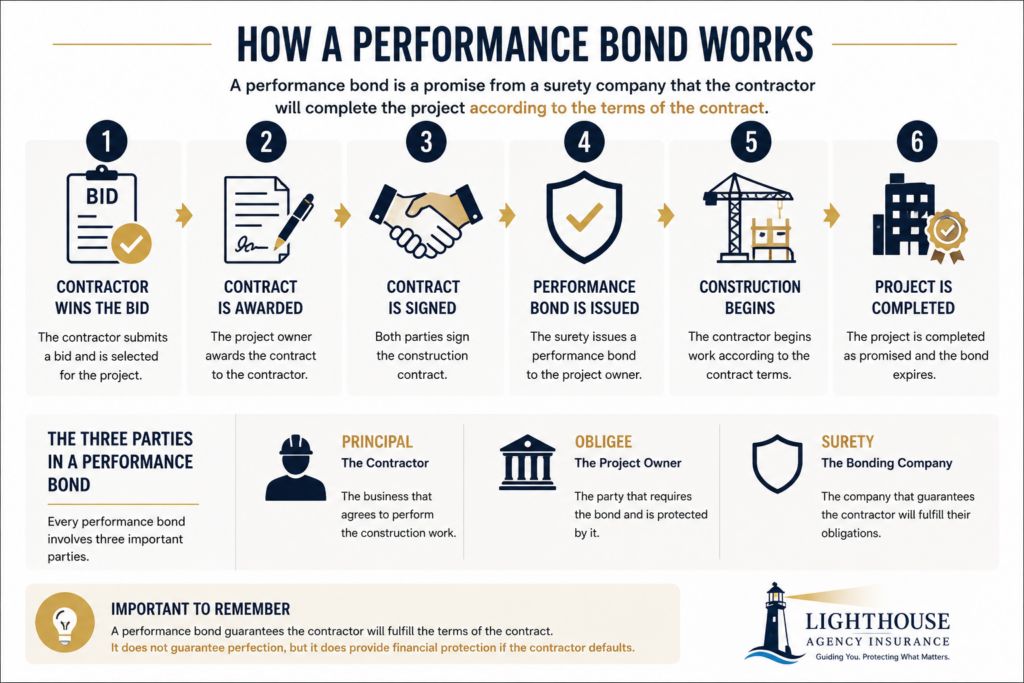
Every performance bond involves three parties:
- Principal — The contractor responsible for completing the work.
- Obligee — The project owner requiring the bond.
- Surety — The surety company guaranteeing the contractor’s contractual obligations.
Once the contractor signs the construction contract, the surety issues the performance bond. If the contractor successfully completes the project, the bond expires without any claim. If the contractor defaults, the project owner may file a claim with the surety.
Unlike insurance, the surety investigates before determining whether a valid default has occurred.
The Performance Bond Process
- Project advertised
- Bid bond submitted (if required)
- Project awarded
- Construction contract signed
- Performance bond issued
- Payment bond issued
- Construction begins
- Project completed
Understanding this sequence helps contractors see where performance bonds fit within the overall construction process.
Bid Bond vs. Performance Bond vs. Payment Bond
| Bond | Purpose | Protects |
|---|---|---|
| Bid Bond | Guarantees the contractor will enter the contract if selected | Project Owner |
| Performance Bond | Guarantees completion of the work according to the contract | Project Owner |
| Payment Bond | Guarantees subcontractors and suppliers are paid | Subs, Suppliers & Owner |
Although they’re frequently issued together, each bond serves a different purpose.
Performance Bond vs. Insurance: What’s the Difference?
One of the biggest misconceptions in the industry is that a performance bond works like an insurance policy. It doesn’t:
| Performance Bond | Insurance |
|---|---|
| Three parties (principal, obligee, surety) | Two parties (insured, insurer) |
| Contractor reimburses the surety for paid claims | No reimbursement for covered claims |
| Guarantees contractual performance | Covers insured losses |
How Much Does a Performance Bond Cost?
One of the first questions contractors ask is: “How much does a performance bond cost?”
Here are real numbers: many contractors pay between approximately 0.5% and 3% of the contract amount, although actual premiums vary based on the contractor’s financial strength, experience, project size, and the surety’s underwriting guidelines.
- Newer contractors or those with weaker financials: commonly 1%–3% of the contract amount
- Established contractors with strong financials and bonding history: often 0.5%–1.5%, with rates typically decreasing on larger contracts
So on a $500,000 public project, a typical premium might fall between $5,000 and $15,000 depending on the contractor’s financial profile.
Premiums are based on factors including:
- Contract amount
- Contractor financial strength
- Experience and project history
- Credit history
- Working capital
- Current backlog
- Project complexity
- Existing surety relationship
Rather than focusing only on premium, contractors should focus on strengthening the financial characteristics that sureties evaluate.
Lighthouse Insight
Contractors often focus on finding the lowest premium. In our experience, the better long-term strategy is building a strong surety relationship. Contractors with consistent financial reporting and successful project history often find they qualify for larger bonding programs over time — not just lower premiums.
What Happens If a Contractor Defaults?
Not every project problem results in a bond claim. If the owner believes the contractor has defaulted under the construction contract, they may notify the surety.
The surety then:
- Reviews the construction contract.
- Investigates the alleged default.
- Determines whether the bond applies.
- Selects an appropriate remedy if necessary.
Depending on the bond language, the surety may:
- Help the original contractor complete the work.
- Arrange for another qualified contractor.
- Finance project completion.
- Compensate the owner up to the bond amount.
Every claim depends on the facts, the contract, and the bond language.
What Doesn’t a Performance Bond Cover?
Performance bonds do not guarantee that every disagreement on a project will be resolved in the owner’s favor. They generally are not intended to cover:
- Routine warranty work
- Minor punch-list items
- Scope changes
- Payment disputes unrelated to default
- Maintenance obligations
- Every construction defect
- Owner convenience terminations
- Design errors
- Delays caused by the owner
- Acts outside the construction contract
The specific bond form and contract ultimately control coverage.
Common Reasons Performance Bond Claims Occur
Although claims are relatively uncommon, they often involve situations such as:
- Contractor abandonment
- Financial insolvency
- Failure to perform according to the contract
- Inability to complete the project
- Major scheduling failures that constitute contractual default
Understanding these risks helps contractors appreciate why project owners require bonding.
How Contractors Qualify
Surety companies evaluate much more than credit. Common underwriting factors include:
- Financial statements
- Working capital
- Cash flow
- Project history
- Equipment
- Experience
- Banking relationships
- Current backlog
- Organizational strength
- Management experience
Of all the financial metrics sureties review, working capital is often one of the most important because it demonstrates your company’s ability to fund ongoing operations while projects are underway.
Larger projects generally require more detailed financial information.
How Contractors Increase Their Bonding Capacity
Bonding capacity rarely increases overnight. Contractors who consistently improve the following areas often qualify for larger projects over time:
- Strong working capital
- CPA-prepared financial statements
- Consistent profitability
- Successful completion of similar projects
- Good communication with their surety
- Controlled backlog growth
Lighthouse Insight
One thing we’ve learned working with Ohio contractors is that bonding capacity isn’t built by simply asking for larger bonds. It’s earned over time through successful project completion, sound financial management, and consistent communication with your surety.
Contractors who prepare well before bid day typically enjoy smoother underwriting and greater long-term bonding flexibility.
Common Misconceptions
“Performance bonds are insurance.” They’re not. Surety bonds involve three parties and generally require reimbursement if the surety pays a valid claim.
“Performance bonds guarantee perfect construction.” No. They guarantee contractual performance — not perfection.
“Every contractor automatically qualifies.” Qualification depends on underwriting.
“The surety pays every claim.” No. Every claim is investigated before the surety determines its obligations.
Frequently Asked Questions
What does a performance bond cost?
Many contractors pay between approximately 0.5% and 3% of the contract amount, depending on financial strength, experience, project size, and the surety’s underwriting guidelines. See the cost section above for a worked example.
How long does a performance bond last?
A performance bond typically remains in effect for the duration of the construction contract, through project completion and acceptance by the owner. Many bonds also include a maintenance or warranty period — commonly one year after completion — depending on the contract and bond form.
Can I get a performance bond with bad credit?
Often, yes. Credit is only one underwriting factor, and specialty surety programs exist for contractors with credit challenges. Expect a higher premium, and in some cases additional requirements such as funds control or collateral. Strong financial statements and a solid project history can offset credit issues.
What happens if a claim is filed?
The surety reviews the contract, investigates the alleged default, and determines whether the bond applies. If it does, the surety may arrange completion, finance completion, or compensate the owner up to the bond amount — and the contractor is generally obligated to reimburse the surety.
Do subcontractors ever need performance bonds?
Yes. General contractors often require performance bonds from subcontractors on larger scopes of work, for the same reason owners require them from GCs: to protect the project if a key sub can’t finish the job.
Can a project owner waive the performance bond requirement?
Private owners can choose to waive bonding. On public projects in Ohio, bonding is generally required by law and cannot be waived.
Can a performance bond be canceled?
Generally, no. Unlike an insurance policy, a performance bond cannot be canceled once issued — the surety’s obligation runs for the life of the bonded contract.
Can a performance bond be transferred to another project or contractor?
No. Each bond is specific to one contract and one principal. A new project — or a change in the contracting entity — requires a new bond.
What documents speed up approval?
Current financial statements (CPA-prepared for larger bonds), a work-in-progress schedule, business and personal financial information, a copy of the contract, and bank references. Having these ready before bid day significantly reduces delays — see the checklist below.
Performance Bond Readiness Checklist
Before you apply, have these ready:
- ✓ Financial statements updated
- ✓ CPA-prepared statements (if applicable)
- ✓ Work-in-progress schedule
- ✓ Bank reference
- ✓ Project contract
- ✓ Owner information
- ✓ Current backlog
- ✓ Existing bond program details
- ✓ Resume of management team
- ✓ Personal financial statement (if requested)
Contractors who show up to underwriting with this package complete move through approval faster and present themselves as lower-risk partners.
Why Work With Lighthouse Agency Insurance?
Obtaining a performance bond is about more than meeting a contract requirement. The right surety relationship can help position your business for larger projects, increased bonding capacity, and long-term growth.
At Lighthouse Agency Insurance, we work with contractors throughout Ohio to explain the bonding process, prepare underwriting information, and connect businesses with experienced surety markets that fit their goals. We can also review your broader risk program, from contractors insurance to bonds of every type.
Whether you’re obtaining your first performance bond or expanding into larger public work, our objective is to provide clear guidance that helps you move forward with confidence.
The Bottom Line
Understanding performance bonds before you sign a construction contract can help you avoid delays, strengthen your bonding relationship, and prepare your business for larger opportunities in the future.
Whether you’re pursuing your first bonded project or expanding your bonding capacity, taking time to understand the process today can make tomorrow’s projects much easier.
Need a performance bond for an upcoming project? Our team works with contractors across Ohio to answer questions, prepare bonding applications, and secure performance bonds from experienced surety providers. Contact Lighthouse Agency Insurance today to discuss your upcoming project and your bonding needs.