
Written by Joshua Mull, Licensed Insurance Agent
Lighthouse Agency Insurance | Last Updated: June 2026
Information in this guide reflects current surety bonding practices and requirements for Ohio contractors as of 2026.
Who This Guide Is For: This guide is written for Ohio-based contractors — including general contractors, electricians, plumbers, excavators, and specialty trades — who are preparing to bid on public construction projects and want to understand how bid bonds work, what they cost, and how to qualify.
Key Takeaways
- A bid bond protects the project owner, not the contractor — it guarantees you’ll sign the contract and obtain final bonds if awarded the project.
- For newer contractors, bonding costs can be as much as 3% of the contract amount — but decrease as your business and track record grow.
- Credit score is only one factor — sureties evaluate your entire business, including cash flow, working capital, and project history.
- Waiting until the day before bids are due is one of the most common — and avoidable — bonding mistakes.
- Being declined today doesn’t mean you’ll be declined in six months. Bonding capacity grows as your business strengthens.
What Is a Bid Bond? (Short Answer)
If you’re preparing to bid on a public construction project in Ohio, one of the first requirements you’ll probably encounter is a bid bond.
A bid bond is a type of surety bond that guarantees a contractor will honor the bid they submitted, sign the contract if awarded the project, and obtain any required performance and payment bonds.
Unlike traditional insurance, a bid bond does not protect the contractor. Instead, it protects the project owner while demonstrating that a qualified surety company believes the contractor is capable of performing the work.
Bid bonds are commonly required on public construction projects throughout Ohio and are also used on many private commercial developments.
Why Are Bid Bonds Required?
When owners advertise construction projects, they’re looking for more than just the lowest number. They’re looking for confidence.
Without a bid bond, a contractor could submit the lowest bid, win the project, and later decide not to sign the contract — or discover they can’t obtain the required performance bond. If that happens, the owner may have to:
- Reject the winning bid
- Award the project to the next-lowest bidder
- Rebid the project entirely
- Delay construction
- Pay significantly more than originally expected
A bid bond helps reduce those risks. Because a surety company reviews the contractor before issuing the bond, the project owner gains confidence that the bidder has already passed an important financial and operational review.
How Does a Bid Bond Work?
Every bid bond involves three parties:
Principal — The contractor submitting the bid.
Obligee — The project owner requiring the bond.
Surety — The surety company guaranteeing the contractor’s obligations.
If the contractor wins the project, they’re expected to honor the price submitted, sign the contract, and obtain any required performance and payment bonds. If they refuse or cannot fulfill those obligations, the project owner may file a claim against the bid bond.
Unlike an insurance policy, the surety generally expects reimbursement from the contractor for any claim it pays.
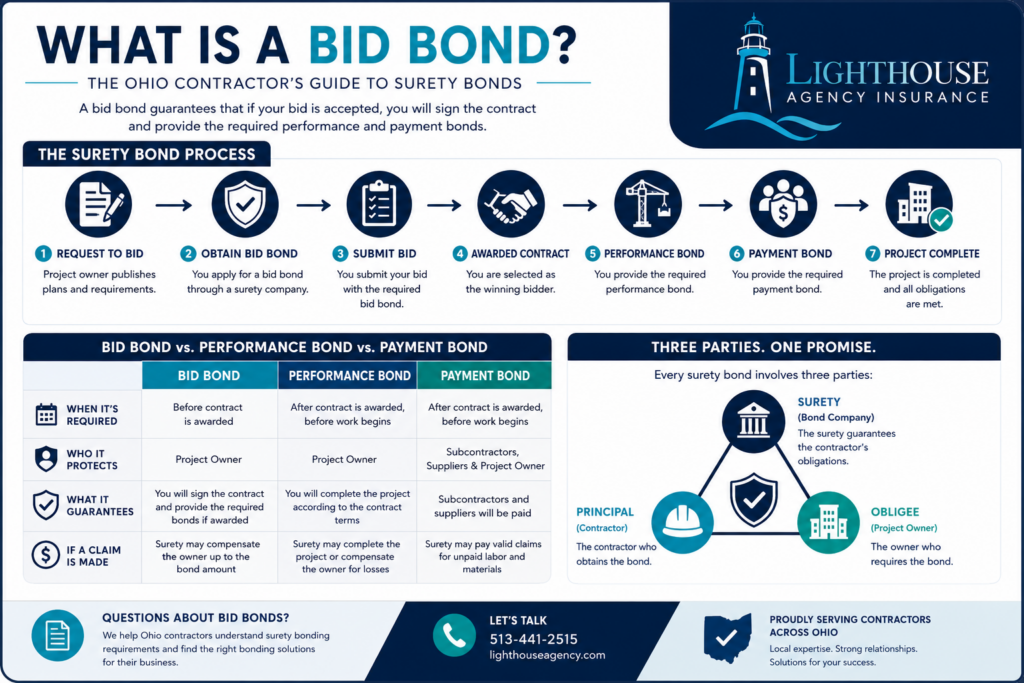
Bid Bond vs. Performance Bond vs. Payment Bond
| Bond | Purpose | Protects |
|---|---|---|
| Bid Bond | Guarantees the contractor will enter the contract if awarded | Project Owner |
| Performance Bond | Guarantees completion of the project per the contract | Project Owner |
| Payment Bond | Guarantees subcontractors and suppliers will be paid | Subcontractors, Suppliers, Project Owner |
What Does a Bid Bond Guarantee?
A bid bond generally guarantees that the contractor will honor the bid submitted, sign the contract if selected, and obtain any required performance and payment bonds.
A bid bond does not guarantee that the project will be completed successfully. That responsibility belongs to the performance bond issued after the contract is awarded.
💡 Lighthouse Insight
One misconception we hear from contractors is that obtaining a bid bond automatically guarantees they’ll receive a performance bond later. That’s not always the case. Sureties continue evaluating contractors throughout the bonding process. Significant changes in financial condition, project scope, or working capital can affect final bond approval. That’s one reason it’s important to work with a surety partner before bids are due — not the day before.
Who Needs a Bid Bond in Ohio?
Bid bonds are most commonly required on public construction projects. Common examples in Ohio include:
- Ohio Department of Transportation (ODOT) highway and resurfacing projects
- County and municipal construction — road work, utilities, public buildings
- School district renovations and new construction (such as Columbus City Schools)
- Water and sewer authority projects — waterline replacements, treatment facilities (such as Hamilton County)
- State agency construction and public infrastructure projects
- Larger private commercial developments where owners require prequalification
If you’re expanding into public work for the first time, your surety relationship becomes just as important as your contractor insurance program.
Who Usually Doesn’t Need a Bid Bond?
Many contractors working exclusively in residential construction or small private projects may never need one — including residential remodeling, home additions, interior renovations, and service work. However, contractors looking to grow into public construction should prepare for bid bonds to become part of the bidding process.
Letter of Bondability vs. Bid Bond
A Letter of Bondability is a letter from a surety indicating that the contractor appears capable of obtaining the required performance and payment bonds. It is not a guarantee, not a bid bond, and does not create financial protection for the project owner. Project owners often request these during prequalification before projects are officially advertised.
How Much Does a Bid Bond Cost?
The honest answer is: it depends on your experience, financial strength, and relationship with your surety.
If you’re a newer contractor or just establishing your bonding program, the overall cost of obtaining bid and contract bonds can effectively be as much as 3% of the contract amount, depending on your financial profile, experience, and the surety’s underwriting requirements.
As you successfully complete bonded projects, build company assets, strengthen your financial statements, and establish a positive track record, your bonding costs often decrease over time. Contractors with strong financials and an established bonding history generally receive more favorable rates and greater bonding capacity.
For many well-established contractors, individual bid bonds are often issued at no separate charge when they lead to performance and payment bonds through the same surety — considered part of the overall bonding relationship rather than a standalone purchase.
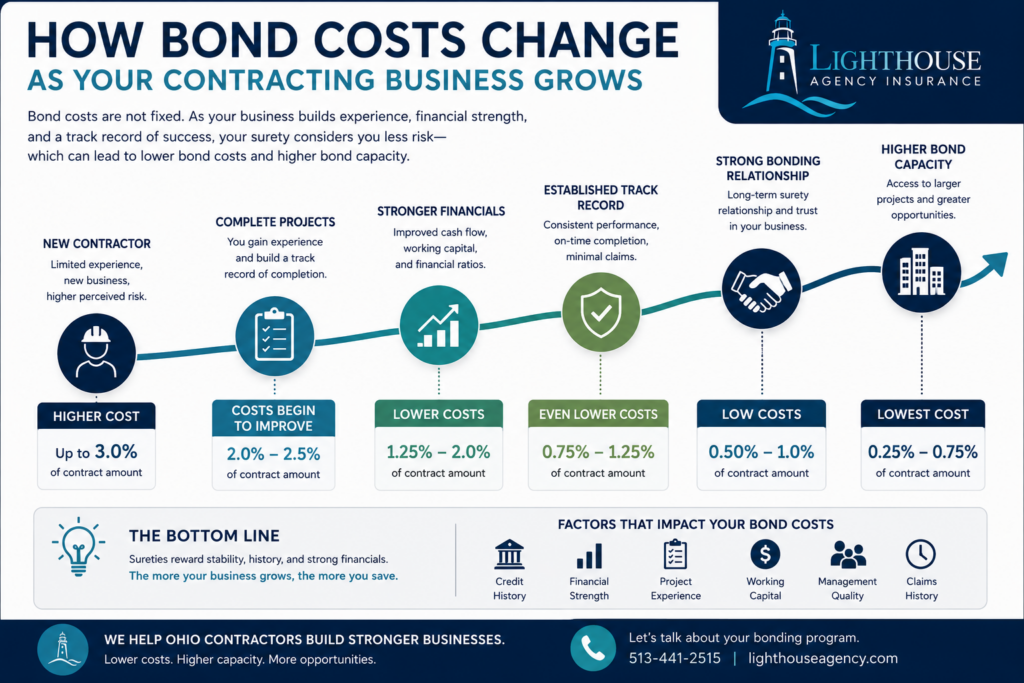
What Factors Affect Bid Bond Costs?
- Your company’s financial strength and working capital
- Business experience and history completing similar projects
- Credit history
- Company assets and net worth
- Current backlog and cash flow
- The size and complexity of the project
- Your existing relationship with the surety
What Helps Keep Bonding Costs Lower?
- A history of successfully completing bonded projects
- Strong financial statements and healthy working capital
- Positive cash flow and consistent profitability
- Company assets and a solid net worth
- Good credit and established banking relationships
- An ongoing relationship with the same surety company
💡 Lighthouse Insight
Surety bonding isn’t just something you purchase — it’s something you build over time. We’ve worked with many Ohio contractors who started with higher bonding costs because they were newer businesses or had limited financial history. As they completed projects, strengthened their balance sheets, and established trust with their surety, their bonding costs declined and their capacity increased. Being declined today — or paying a higher rate today — doesn’t reflect where your business will be a year from now.
How Do Ohio Contractors Qualify for a Bid Bond?
Common underwriting considerations include:
- Business experience and project history
- Financial statements and credit history
- Current backlog and available working capital
- Cash flow and equipment
- Banking relationships and management experience
- Personal indemnity (when required)
Can You Get a Bid Bond With Bad Credit?
Sometimes. Credit is important but it’s only one part of the evaluation. A contractor with average credit but strong financials may present less risk than one with excellent credit and weak financial statements. Every situation is unique.
How Long Does It Take to Get a Bid Bond?
For contractors with an active bonding program, bid bonds can often be issued quickly once project information is received. For first-time requests or significantly larger bonding capacity, the process may take several days or longer. Begin the bonding process well before bid day — waiting until the afternoon before bids are due leaves very little room to resolve unexpected underwriting questions.
Contractor Readiness Checklist
Before requesting a bid bond, have these ready:
- ☐ Current financial statements
- ☐ Work-in-progress schedule
- ☐ Project specifications and contract amount
- ☐ Bid date and ownership information
- ☐ Banking information
- ☐ Current insurance information
- ☐ Existing bonding history
- ☐ CPA financial statements (if available)
Common Reasons Contractors Are Declined
- Limited experience with similar-sized projects
- Weak financial statements or insufficient working capital
- Excessive backlog or cash flow concerns
- Significant tax issues or incomplete financial information
- Rapid growth without adequate capitalization
Being declined today doesn’t necessarily mean you’ll be declined six months from now.
What Happens If You Win the Bid?
Winning the bid is an exciting milestone — but it isn’t the end of the bonding process. The project owner will ask you to sign the contract, provide a performance bond, provide a payment bond, and meet any additional contract requirements before work begins.
Your surety may perform additional underwriting before issuing the final bonds. Maintain open communication throughout — not just on bid day.
What Happens If You Don’t Win the Bid?
If your proposal isn’t selected, your bid bond typically expires without any further action. There is no claim, no refund process, and no ongoing obligation. For your next project, simply request a new bid bond.
What Happens If a Bid Bond Claim Is Filed?
If a contractor refuses to sign the contract after winning — or cannot provide the required performance and payment bonds — the project owner may submit a claim to the surety. The surety investigates, determines whether the claim is valid, and resolves it. If the surety pays, it generally seeks reimbursement from the contractor. This is one of the key differences between surety bonds and insurance.
Common Bid Bond Mistakes Ohio Contractors Make
Waiting Until the Last Minute: Bond underwriting takes time. Requesting a bid bond the day before bids are due leaves little opportunity to resolve questions or provide additional financial information.
Assuming Every Project Uses the Same Bond Form: Different owners may require different bond forms. Submitting the wrong form can result in your proposal being rejected. Always review project specifications carefully.
Bidding Projects Beyond Your Bonding Capacity: Know your capacity before you bid. Taking on projects that significantly exceed previous experience may create underwriting challenges.
Failing to Keep Financial Statements Current: Outdated statements can delay approvals and raise unnecessary underwriting questions.
Not Building a Surety Relationship Early: Waiting until you need a bond before contacting a surety professional is one of the most common mistakes new contractors make.
Bid Bond Ohio: Frequently Asked Questions
For a complete list of contractor bonding questions, visit our Ohio Contractor Bond FAQ page.
Is a bid bond required for every construction project? No. Requirements vary by project owner and contract. Many public projects require bid bonds; many residential and smaller private projects do not.
What percentage is a bid bond? Many public projects require bid bonds equal to 5%, 10%, or another amount specified in the bid documents. Always review project specifications.
Can I reuse a bid bond on another project? No. Bid bonds are issued for a specific project and cannot be transferred.
How long is a bid bond valid? The bid bond remains effective for the time period outlined in the bid documents and expires once the contract is awarded or the bidding process ends.
Can new contractors qualify for bid bonds? Yes. Many new contractors successfully obtain bid bonds. Requirements vary depending on experience, financial condition, and project size.
What documents speed up the approval process? Current financial statements, project information, work-in-progress schedules, and business information ready in advance significantly reduce delays.
Ready to Get Your Ohio Bid Bond?
First Time Pursuing Public Work?
If you’re bidding your first public construction project in Ohio, the bonding process can feel unfamiliar. We’ll walk you through exactly what’s needed, help you prepare your underwriting information, and connect you with the right surety market for your business — so you can focus on winning the work.
Speak with Joshua Mull directly: lighthouseinsuranceagency.com/contact
Already Bonded and Looking to Grow?
If you have an existing bonding program but want to increase your bonding capacity, improve your rates, or prepare for larger projects, we can review your current program and identify opportunities to strengthen your position with your surety.
Speak with Joshua Mull directly: lighthouseinsuranceagency.com/contact
Joshua Mull is a licensed insurance agent at Lighthouse Agency Insurance, specializing in commercial insurance and surety bonds for Ohio contractors. Lighthouse Agency Insurance serves contractors across Ohio with general liability, commercial auto, workers compensation guidance, umbrella coverage, and surety bond solutions.