
Written by Joshua Mull
Licensed Insurance Agent and Founder, Lighthouse Agency Insurance
Serving Fairfield, Hamilton, Butler County, Greater Cincinnati, and communities across Ohio
Quick Answer: The Mistake That Costs Homeowners Thousands
Can you combine storm damage from multiple years into one claim? Generally, no. But getting this wrong can cost you a denied claim or a settlement far below what you deserve.
Here’s the problem: Most homeowners don’t understand their roof coverage until after the damage occurs. By then, it’s too late to make the decisions that matter. You’re left guessing, hoping you documented things right, and wondering if the insurance company will actually pay.
You don’t have to be in that position. Understanding your coverage before a storm hits gives you the confidence to make smart decisions when it counts.
Can You Combine Damage From Several Storms Into One Roof Claim?
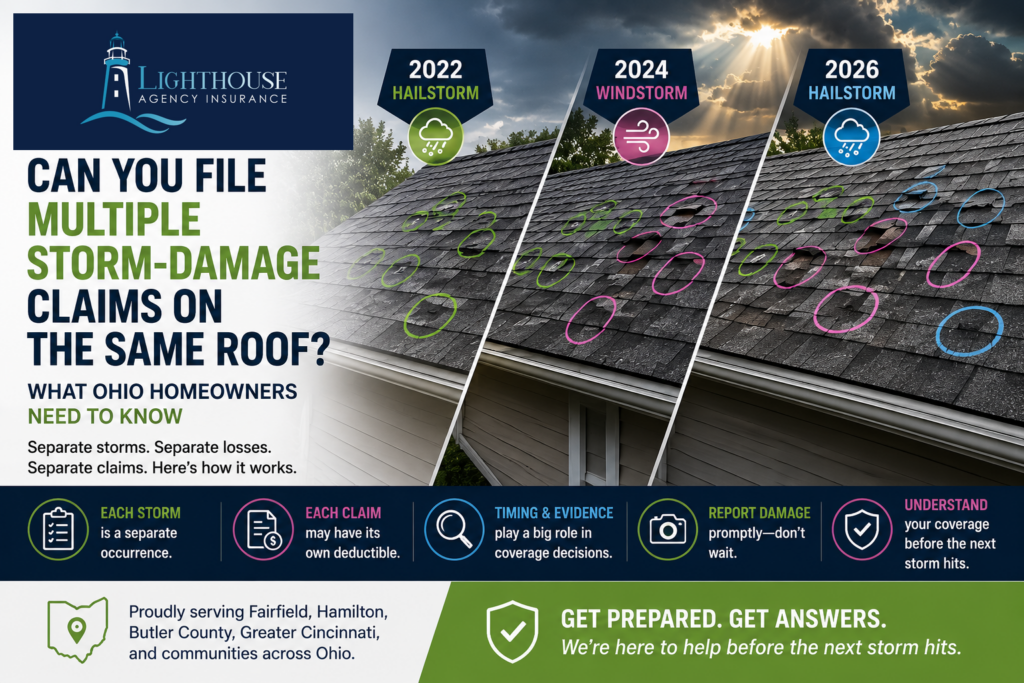
Generally, no. Homeowners insurance usually evaluates roof damage based on a particular occurrence—a specific event, such as a hailstorm, windstorm, or tornado. If your roof was damaged by separate storms on different dates, an insurance company may treat the damage as separate losses.
Each loss may involve: a separate claim, a separate deductible, a separate investigation, and different policy terms or coverage dates.
The final decision depends on your policy language, the available evidence, the reported dates of loss, and the insurer’s investigation. This is why reporting suspected storm damage promptly matters. The longer you wait, the harder it may become to determine which storm caused the damage.
What Is an Occurrence in Homeowners Insurance?
An occurrence is generally a particular event that results in damage. Examples could include a hailstorm on a specific date, a windstorm that removes or creases shingles, a tornado that damages the roof and exterior, or a fallen tree caused by a covered storm.
By contrast, gradual deterioration over several years, normal aging, long-term exposure to sun/rain/temperature changes, poor maintenance, and repeated minor damage with no identifiable date of loss are generally not single storm occurrences.
Homeowners insurance is intended to cover losses caused by covered perils. It is not designed to function as a maintenance plan for an aging roof.
Can You File More Than One Claim on the Same Roof?
Potentially, yes. A homeowner may be able to file separate claims when separate storms cause separate damage. However, filing multiple claims does not mean every claim will be covered or that the insurer will replace the roof each time.
The more difficult situation occurs when a homeowner notices damage but cannot identify when it happened. If several storms have occurred, the insurer may need to determine which event caused the damage, whether some damage existed before the policy began, whether previous damage was repaired, whether deterioration contributed to the current condition, and whether one or more deductibles apply.
Why Can’t Years of Storm Damage Be Combined?
Each storm may be a separate loss. A storm in 2024 and another storm in 2026 are usually separate events. An insurer generally cannot assume all visible damage came from whichever storm the homeowner most recently reported.
The roof changes over time. Between storms, a roof continues to age and may experience heat and ultraviolet exposure, freeze-and-thaw cycles, heavy rain, wind, debris impact, foot traffic, and repairs or alterations. Those changes can make it difficult to separate recent storm damage from older damage or deterioration.
Each claim may involve a deductible. If two separate storms caused covered damage, the policy may apply a deductible to each occurrence. This can materially affect whether filing one or both claims makes financial sense.
Delayed reporting makes causation harder to establish. When significant time passes before an inspection, photographs may not exist, additional storms may have occurred, temporary or permanent repairs may have changed the evidence, weather exposure may have altered the roof’s condition, and the precise date of damage may be difficult to verify.
Storm Damage vs. Normal Wear and Tear
One of the most important questions in a roof claim is whether the condition resulted from a covered storm or gradual deterioration. Storm damage includes missing or wind-lifted shingles, creased or torn shingles, impact marks consistent with hail, punctures caused by debris, sudden damage after a documented event, and damage consistent with surrounding storm evidence.
Wear and tear includes brittle shingles caused by age, curling or cupping over time, granule loss from normal aging, fading caused by sun exposure, long-term leaks or deterioration, and poor installation or deferred maintenance.
Does an Older Roof Still Qualify for Coverage?
An older roof may still have coverage for damage caused by a covered event. However, age and condition can affect both the investigation and the payment.
Your policy may settle roof damage based on replacement cost (which may initially withhold depreciation and make it recoverable after covered repairs are completed), actual cash value (which subtracts depreciation based on the roof’s age, condition, expected useful life, and materials), a roof payment schedule (some policies use a roof-surface payment schedule or endorsement that limits payment based on the roof’s age or material), or cosmetic-damage limitations (some policies restrict or exclude damage that affects appearance but does not impair the roof’s ability to function).
Is There a 30-Day Deadline for Filing an Ohio Roof Claim?
There is no universal 30-day filing deadline that applies to every Ohio homeowners policy. Your policy may require you to provide prompt notice, immediate notice, or notice as soon as reasonably possible after a loss.
The practical advice is simple: report suspected damage as soon as reasonably possible. Prompt reporting helps preserve evidence and gives the insurer an opportunity to inspect the property before conditions change.
What Should You Do After a Storm?
Put safety first. Do not climb onto a wet, steep, unstable, or damaged roof. From a safe location, look for missing shingles, fallen branches, damaged siding or gutters, water entering the home, debris impact, and damage to outdoor structures.
Prevent additional damage. Homeowners policies generally require insureds to take reasonable steps to protect the property from further damage. This might include placing a tarp over an opening, moving belongings away from a leak, removing standing water, boarding a broken window, or arranging reasonable emergency repairs.
Document what you can. Take photographs or video of the roof from a safe location, gutters and downspouts, siding, windows, and exterior structures, interior water damage, fallen trees or debris, and temporary repairs.
Review your deductible and coverage. Before filing, locate your declarations page and check for your all-peril deductible, a separate wind or hail deductible, replacement-cost or actual-cash-value coverage, roof-surface endorsements, cosmetic-damage exclusions, and applicable coverage limits.
Contact your insurance agent or company. Explain what happened without guessing or exaggerating. A helpful description might be: “We had a windstorm on June 10, and I noticed missing shingles and water staining the next morning.”
Consider a reputable roof inspection. A qualified roofer can help document the roof’s condition and identify areas that may need repair. However, a contractor does not decide whether your insurance policy covers the damage.
Be cautious of anyone who guarantees that insurance will buy you a new roof, encourages you to report an inaccurate date of loss, offers to waive or absorb your deductible improperly, pressures you to sign immediately, asks you to sign over insurance benefits without explanation, or claims every mark on the roof is covered hail damage.
What Happens During the Claim Investigation?
The insurer collects information about the event, including the suspected date of loss, the type of storm, when the damage was discovered, temporary repairs, interior damage, and prior roof repairs or claims.
An adjuster or other representative may examine shingles or roofing materials, flashing and roof penetrations, gutters and vents, siding and exterior surfaces, interior water damage, signs of age or installation problems, and damage patterns consistent with wind or hail.
The insurer compares the findings with your policy language, weather information, photographs, inspection results, prior claims or repairs, contractor documentation, and the reported date of loss.
The claim may be covered in full, covered in part, below the deductible, limited by an endorsement, or denied based on the policy or investigation. If coverage is denied or limited, request the explanation in writing and ask which policy language applies.
When a claim is covered, the estimate may account for labor and materials, the scope of covered repairs, your deductible, depreciation, code-upgrade coverage, matching considerations, policy limits and endorsements, and prior unrepaired damage.
How Adjusters Actually Verify Your Damage
When an adjuster inspects your roof after a storm, they’re matching your damage to actual weather data from that specific date and location.
Modern insurance uses precise weather databases that track wind speeds on the exact date of loss, hail size during the storm event, storm path and timing, and temperature and precipitation data.
An adjuster will look at your roof and ask: Do these impact marks match 1.5-inch hail? Are these wind patterns consistent with 60+ mph gusts on June 10?
Real Example: A homeowner in Hamilton reports hail damage from a June 15 storm. The weather data confirms hail event occurred on June 15, hail size was 1.25 inches, storm duration was 45 minutes, and wind gusts were 35 mph. The adjuster inspects the roof and sees impact marks consistent with 1.25-inch hail. The damage pattern matches the storm path. Everything aligns. Claim approved.
But if that same homeowner waited 8 months to report the damage: no contemporaneous photos exist, two additional storms have occurred, deterioration has affected the roof, and the adjuster can’t confidently match damage to the June 15 event. Result: The investigation becomes harder, the evidence weaker, and coverage becomes questionable.
Most homeowners policies require you to report a loss promptly or as soon as reasonably possible after discovering damage. Delaying the report can make it more difficult for the insurance company to investigate the cause, determine when the damage occurred, and evaluate coverage. Review your specific policy for its notice requirements and any applicable deadlines.
Why timing matters: Weather records become harder to correlate with old damage, your roof continues to age and deteriorate, evidence degrades (photos fade, debris clears, temporary repairs are made), and additional storms muddy the picture. The closer you report to the actual storm date, the clearer the picture.
Insurance companies now use sophisticated mapping and data tools that show exact storm tracks overlaid on your property location, precise hail size distribution across neighborhoods, wind speed variations block by block, and comparison of reported damage patterns to actual weather events.
This technology helps insurers evaluate claims using weather data and other available evidence. But it also makes it much harder to establish a clear connection between your damage and a specific storm if you wait months to report it.
When you report promptly, you’re giving the adjuster the tools they need to investigate your claim thoroughly and fairly.
How Quickly Must an Ohio Insurer Respond?
Ohio’s property-and-casualty claims-settlement rules generally require an insurer to acknowledge receipt of a claim within 15 days. After receiving properly executed proof of loss, an insurer generally has 21 days to accept or deny the claim or explain why additional investigation time is needed.
Common Roof-Claim Misconceptions
“Every hail mark means I get a new roof” – Not necessarily. Coverage depends on whether a covered event caused direct physical damage, what the policy covers, the extent of the damage, whether repairs are possible, and whether exclusions or limitations apply.
“My neighbor got a new roof, so I should get one too” – Your neighbor may have a different insurer, different policy language, a different deductible, a newer or older roof, different damage, different endorsements, or a different date of loss. Every claim is evaluated individually.
“Insurance replaces a roof when it gets old” – Homeowners insurance is not designed to replace a roof solely because of age. It may cover sudden damage caused by a covered event, subject to the policy.
“I should wait until more storms occur so the claim is worthwhile” – Waiting can make it more difficult to establish when the damage occurred and what caused it. It may also allow additional damage to develop.
“My contractor decides whether the roof is covered” – A contractor can assess the physical condition of the roof and provide an estimate. The insurer makes the coverage decision based on the insurance contract and claim investigation.
Before You File a Claim—Know What You’re Actually Asking For
This is where most homeowners make critical mistakes. They file a claim without understanding what their deductible actually costs them, whether they have replacement-cost or actual-cash-value coverage, wind or hail limitations that could dramatically reduce their payout, roof-specific endorsements that affect coverage, or what happens after they file.
The homeowners who get the best outcomes talk to their agent first. Not to get permission—but to understand the game you’re playing. Knowing your deductible, your coverage type, and your roof limitations before you file changes everything about your claim strategy.
We can’t guarantee the insurance company will approve your claim. But we can make sure you understand exactly what you’re asking for and whether filing actually makes financial sense for your situation. That knowledge is the difference between a claim that pays and one that leaves you thousands out of pocket.
What If the Claim Is Denied or You Disagree With the Estimate?
Start by asking the insurer for the decision in writing, the policy provisions relied upon, a copy of the insurer’s estimate, an explanation of any excluded or uncovered items, and instructions for submitting additional documentation.
You may also provide relevant information such as photographs, repair records, contractor estimates, receipts for emergency work, inspection reports, and documentation showing the roof’s pre-loss condition.
For unresolved concerns involving an insurer, Ohio consumers may also contact the Ohio Department of Insurance.
The Bottom Line
You generally cannot combine years of roof deterioration or damage from several unrelated storms into one insurance occurrence. However, separate storms may support separate claims when each event caused identifiable damage and the policy provides coverage. Each claim may be separately investigated and may carry its own deductible.
The best steps are to: report suspected damage promptly, protect the property from further damage, photograph what you can safely observe, keep receipts and repair records, review your deductible and roof coverage, avoid guessing about the cause or date of damage, cooperate with the insurer’s investigation, and ask questions when a coverage decision is unclear.
The Difference Between Being Ready and Being Caught Off Guard
Scenario 1: You Wait Until After the Storm – A hailstorm damages your roof. You file a claim without knowing your deductible is $5,000. The insurance company settles for $8,000. You’re out $5,000 after all that stress and hassle. You wish you’d known beforehand.
Scenario 2: You Understand Your Coverage Now – A hailstorm damages your roof. You know your deductible, your coverage type, and exactly what’s at stake. You file confidently, document properly, and get a settlement that actually makes sense. You handle the process with confidence because you knew what to expect.
The only difference? One conversation before the storm.
Lighthouse Agency Insurance
Serving Fairfield, Hamilton, Butler County, Greater Cincinnati, and communities across Ohio
Call: 513-860-2552
Text: Roof Insurance help to 513-860-2552
Email: JMULL@LHA1.COM
Lighthouse Insight
One of the biggest mistakes we see is homeowners waiting until the next storm season before having their roof inspected. If you believe your home may have suffered wind or hail damage, documenting it promptly gives both you and the insurance company a much clearer picture of what happened. Early documentation doesn’t guarantee coverage, but it can make the claim investigation more straightforward.
Questions? Ask Josh.
How long after a storm should I wait to file a claim?
A: Don’t wait. File as soon as you’ve safely documented damage and notified your agent. Delays can reduce your evidence and complicate the investigation.
If I file one claim, will it raise my insurance rates?
A: That depends on your policy, your insurer, and your claims history. Discuss this concern with your agent before filing.
Can I sue my insurance company if they deny my roof claim?
A: Your policy likely contains dispute-resolution procedures (appraisal, mediation). If you believe your claim has been handled incorrectly, the Ohio Department of Insurance has a free complaint process. You can file a complaint online at insurance.ohio.gov/about-us/complaint-center. The state will review whether the insurer followed Ohio law and policy requirements.
Lighthouse Agency Insurance
Your trusted advisor for homeowners insurance in Ohio
Licensed in Ohio | Serving Fairfield, Hamilton, Butler County, Greater Cincinnati, and communities statewide
This blog provides general educational information and does not constitute insurance advice or legal counsel. Your insurance coverage is determined by your policy document. For questions about your specific coverage or claims, contact your insurance agent or company directly.